Saturday, March 28, 2015

Media Literacy Reflection


When the concept of media literacy was introduced in class, I would not say that anything necessarily surprised me in the presentation.  I had always known that it was difficult sometimes to find a reliable news source or station because of reporters' biases or misconceptions. Here is a choice clip from the Daily Show only supporting this fact, if you are interested:  http://thedailyshow.cc.com/videos/lkmdal/fox-news--false-statements.
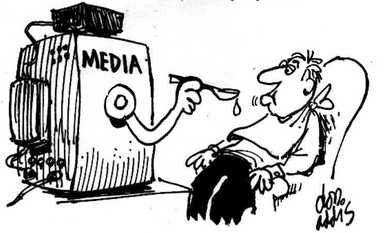
 I had always known that ads exaggerated and stretched the truth.  The only advertisements that I somewhat tolerated were the Superbowl ads and any others that used humor as a selling point.  Those I found less annoying.  However, despite my annoyances with the ads, I found myself falling for them.  Whenever an ad came on describing the amazing effects of this new makeup or hair product, it would prompt me to go online, research it some more to see if it was worth it, and then possible buy it.  When I saw the new meal that Applebee's was serving on the TV, the next time my fiance and I went out for dinner, I would suggest that we go there.   Despite my awareness of the lies and exaggeration that ads live on, I am still a sucker for it.   However, it is better that I have some kind of awareness versus none.  That is why the very impressionable kids of this generation need to be taught how to combat the onslaught of pictures, videos, and words that are trying to convince them of how or what they should decide.
Avoid this.
I do not think that there needs to necessarily be a class every day discussing this topic in a school, but I think that perhaps a teacher, whether it be the homeroom or the technology/keyboarding teacher, should use this topic to lead class discussion at least a few times a month.  Whether the teachers follow a set program for media literacy or come up with it on their own, their students need to know that they are being lied to several times a day by the media.  They need to know how to respond to these falsehoods being shoved into their retinas. The task of a school is to mold these minds into well-balanced, intelligent, hard-working, responsible members of the human race.  Knowledge about media literacy encourages the children to not only use deductive reasoning to uncover the deceptive "truths" but to also internally reflect on their own beliefs.  Media literacy will not only make the students question what the media is trying to make them believe but also what they believe themselves.  Media literacy might not be the first time where students mediate on who they are, but it could be another stepping point to full self-realization.
I cannot see anything negative about teaching this topic in schools.  I believe that it will engage most students because they can all relate to it since it is something that they are surrounded by every waking moment of their lives.  It will teach the students how to uncover the truth and their own person-hood at the same time.  Plus, you get to watch videos for an entire class period.
And only a neanderthal would whine about that.
 Ads are everywhere whether we like it or not, and it is only becoming worse. Obviously they work or else the companies who spend the money to produce the ads would not have money left to produce them.  Our world is obsessed with beautiful people, things, and ideas.  Ad companies pounce on that and eat that as their bread and butter.  We are duped whether we are aware of it or not.  The scary prospect is that we can be unconsciously fooled into buying or believing something.  That is why I believe that this generation needs to have an awareness of what they are being force fed if you will.  The children of this age are surrounded by flashy modern technology that never give them a moment's peace.  These young minds need to be taught how to find the truth amid the noise and confusion.  They must be pushed out of their ignorance and complacency and be fighters for what they believe is right and true.


Sunday, March 22, 2015

Digital Storytelling Experience

When the project of the digital story was presented in class, I was filled with a mixture of feelings.  I was apprehensive about making my own video, but at the same time I was excited to create it as well.  I knew that night that the topic of the video would be about brewing beer.  I had not hashed out the particulars necessarily, but the idea was already ingrained in my mind before class was over.  Later that night, my fiance asked if people would admit me to AA if I used beer as the topic for my digital story.  I told him that since this was our hobby, he would be accompanying me to the sessions if that was the case.
I began the project about a week in advance to give myself ample time.  I am definitely not the most savviest with technology and making a video with audio, narration, etc. made me quite nervous.  Which is why I ran to my tech savvy fiance for assistance.  At first, I started to use Windows Movie Maker on my laptop, but my fiance stopped me and stated that I would only become incensed and suicidal if I used that program.  He then introduced me to the wonderful world of Corel VideoStudio Pro X7.  This amazing tool enabled me to match up my audio, pictures, and music almost effortlessly.  There were also many other tools and animations that Corel offered that one could implement in their project to spice it up.


Here is the link to download a free trial of the updated program yourself or for additional information about the product:

 http://www.videostudiopro.com/en/products/videostudio/ultimate/

The only downside to this was that my personal laptop could not support this program.  I then had to work on my fiance's desktop for the rest of my project.  Which would have been fine except for the fact that his desktop did not have a microphone.  So, I had to record my narration on my laptop and then link it to the desktop.  There were quite a few instances where my narration failed to connect and after hours of working and twiddling with the video, I would only realize the next day that the audio did not save, and I would have to try to link and adjust it again for hours.
 This happened on Sunday night, the night before the project was due.  I had gone on the desktop to download my video onto YouTube, only to discover that my narration audio had disappeared.  You can only imagine the heated and rather base choice of words that I directed towards both computers.  I had worked for many painstaking hours the day before on my digital story, so this was a swift kick in the pants. Knowing me all too well, my fiance handed me a beer and told me that it would work out.  With steam hissing out of my ears, I managed to link the audio, save it, and adjust it to the rest of my story until it was as perfectly timed as the day before.  The rest from then on was smooth sailing.
I was overall pleased with my final product.  The only qualm and difficulty that I struggled with in particular during the creation was the shaky and static sounds that the microphone made during my narration.  I redid my narrative clips many times trying to make that unnatural sound dissipate.   I tried to adjust the volume of my own voice, the location of the microphone, and even used Corel's audio features to try to clean up the audio noise.  In the end, nothing seemed to help and on Sunday night in particular, I was not in the mood to keep trying any longer.
If I had to do this project over again, I would definitely purchase a better quality microphone and add some background music as I instructed my audience on the basics of proper home-brewing. Perhaps I would add some animations or text to the slides as well.  I had also wanted to added a clip of a comedian's skit making fun of New Hampshire and their obsession with drinking, but it would have made the story go over the time limit. However, despite those improvements, I was pleased with the outcome and relieved that it was all over.  I was also very proud of myself that I created my own video and that I now possess the skills to make an even better digital story in the future.   Better stock the fridge with "inspiration" while I am thinking about it now.

Here is the finished product of my digital story on the home-brewing process for your enjoyment:


And for further enjoyment, here is the comedian that I spoke of earlier.  His name is Juston McKinney, and this is his skit on New Hampshire.  Warning: Some rude and crude humor ahead.


Sunday, March 8, 2015

#Twitter #& #PLNs

#Twitter

I had never much interest in joining Twitter.  I believed it to be just another social media outlet where people could comment, complain, and argue about every little thing in their lives.  Facebook was enough; I did not need anything else.  I was forced to join Twitter for this class, and I was not exactly thrilled about it.  I had always thought hash tagging was (to be frank) lame.  I had interpreted it as a fad that people had accepted as another cool way to write and participate on social media.  I had no idea that hash tagging actually had authentic uses when it was not attached to ridiculously long and seemingly unnecessary jumbled words.  When I joined Twitter, I found that the hash tags actually were a way to connect with others versus just looking "cool."  I was slightly relieved to realize that hash tagging was not completely absurd, and I began to follow educational resources as mandated by the class.  I tweeted here and there, mostly for assignment purposes, but then as time went on, I found myself checking Twitter a few times a day just for *gasp* fun.  I read a plethora of articles about education, current events, and entertainment.  I began to enjoy tweeting or even retweeting links to articles I found interesting or important.  Basically, my experience with Twitter was not as awful or annoying as I had expected it to be.  I greatly appreciated the fact that you could only type 140 characters.  Unlike Facebook, where an individual could drone on and on about their opinion for a good two pages worth, Twitter forced you to be brief and get to the point.  Attach the link, little blurb, then tweet.  I believe that that has contributed to Twitter's success.  People are able to go on Twitter, read some bite size information, and then they have the choice to click on the link and indulge or not.  I have found that there are wonderful resources to be found on Twitter, and I have sincerely enjoyed being able to easily find tips, advice, and innovative ideas to enrich my own career as an educator.  My eyes have been slightly opened to the possibilities that Twitter can offer an educator.  I would not go as far as to say that I have been completely converted or even addicted to Twitter, but I can admit that I do not dub hash tagging as "lame" any more.  Unless you do not have a Twitter.  Then it is still lame.


FYI: Here is a link to my personal Twitter feed:  https://twitter.com/sugarnspice523

#Educational Resource via Twitter

Going back to my comment earlier about the ease of finding resources for educator, I specifically found one article that I wished I had read years before.  I found it on Edutopia (@edutopia) on Twitter.  Edutopia is a site providing insights and information on how to make teaching and education more effective.  It is one of the many education resources that I follow on Twitter, and it is one of the main sources that I retweet from.  This particular article first grabbed me by its title: "5 Tips for Teaching the Tough Kids."  Every teacher would hop on this, right?  There are tough kids in any class and and any advice on how to handle them is more than appreciated.  In my own personal experience, when I taught as a 2nd grade teacher, I had one tough kid in particular that I fought with every day.  He changed the whole dynamic of the classroom and stubbornly ignored any suggestions to correct his behavior.  I felt at a loss many days on to how to manage this child.  So, when I came across this article in my Twitter feed, I pounced on it.  I thought to myself, "What can I do better in the future for the tough kids that I am bound to have in my class?"
The article explain five ways that a teacher could approach these kids and how to even turn them into positive leaders in your classroom. The five tips were as follows:

1. Set the Tone.
 A teacher must let the "tough kids" know that despite the label that has been given to them, the teacher still believes in them and wants that child to know that.  Create a positive and safe atmosphere within the classroom for learning.
2. Be a Good Mentor
Most tough kids come from difficult homes or family situations.  They act out because they are vying for attention even if it is in a negative form.  They need stability and an adult that will be there for them.  Be a supportive and trustworthy mentor, and it can change a child's life drastically.
3. Make Connections
Now that you are a mentor to these children, you have the opportunity to really connect with them.  Talk about issues or interests outside of school.  Really understand where these children are coming from and who they are as people.  Be honest, genuine, and show a real interest in what they are interested in.
4. Take It Personally
What the author meant by this is that students will say things to teachers that hurt or belittle them and/or their teaching skills.  Sometimes it is unintentional and sometimes not.  These kids want to get under the teacher's skin and make them feel inadequate since that is how they are personally feeling about themselves. Teachers need to deal with these comments at that moment and use the comments to improve their teaching.  Address the comments in class and support these students in their endeavors.  Help them prove to themselves that they can accomplish any goal they set.  These kids are written off as hopeless; you need to help instill hope within  themselves.
5. Expect Anything and Everything!
The author reiterates that the tough kids will come from anywhere (cultures, countries, etc.) and have experienced almost everything.  Be prepared to handle any and all situations and to never give up on them.  You might be the only trusting, stable, adult relationship that these kids have.

As I stated above, I wish I had read this article before I had even taught.  It provided me with great tips on how to effectively work with the tough kids, and now I can utilize them in my future classroom.  I found this tiny article link on Twitter, and I found myself inspired in the end.  Just a small example of how Twitter is an excellent resource for educators.
To read the article in its entirety, here is the link: http://t.co/YngVfDRsNE

#PLNs--#ntchat

I was wary about the participating in a live twitter chat with a PLN (Professional Learning Network) just because it seemed so daunting and unfamiliar.  I decided to join the New Teacher chat (#ntchat) since I figured that that would be a chat that I could extract some knowledge from and there would be others like me participating as well.  I signed onto Twub so that I could manage the speed of the chat, but found that the chat was not moving quickly at all.  The host was late arriving for the chat and then it seemed that the questions were slow in posting.  I ended up chatting on the actually Twitter site instead since the chat seemed to be moving a little faster on that end.  The topic for the chat was social studies and how to implement different methods to teach it within the classroom.  Veterans and newbie teachers joined and answers were given.  I found that many of the ideas were very brilliant and commented and/or favorited several of the posts.  I did not think that the twitter chat was a life changing experience, and there were even times when I thought it slightly dull.   However, I felt that it was another great resource, especially for new teachers, to participate in and gather more knowledge and advice to better their teaching techniques.

Screenshots of my live twitter chat:

Question 1 was: What is the purpose of teaching Social Studies in the classroom?

Question 2 was: What strategies can we use in social studies to reach beyond the classroom walls to make global                                                                                                              connections?


Question 3 was: Do social studies textbooks still have a place in today's classrooms? 


Friday, February 27, 2015

The Stages of Technology Integration


After reviewing the stages, I believe that I would have to label myself as being in the 2nd stage (Adoption) of Technology Integration within the classroom.  I have never been completely against using technological tools in my lessons, but at the same time I have also been wary about technology taking the spotlight in my lessons versus just assisting them.  I have used videos, music and a Smartboard to teach lessons before.  However, the private school that I taught for did not have the funds to have many technological tools within the classrooms.  Heck, we barely had one functioning computer in the entire school.   I never felt that I needed any other advanced tools in my classroom and that we were getting by with what I was able to use on my iPhone.  I think part of this mentality was due to the fact that I knew that I would never be able to have any techie gadgets since the school would never be able to afford it.  So, I powered through it, and would like to say I succeeded all the same.
Hence, I have felt that even though I'm sure certain modern tools could be very helpful, fun, and effective during lessons, I did not want my classroom to be another outlet for children to stare at screens all day.  I do believe that as a teacher you have to stay current and be aware of the tech tools out there that can be utilized, but I also believe that a student still needs to learn the traditional ways with pen and paper.  There is a necessary skill that cannot be taught with touchscreens.  Coordination, precision, and physical dexterity are skills that one can attain through the use of pen, paper, crayons, glue sticks, and other handy school supplies.  These skills should be not be overlooked just because they are not flashy or the latest fad.  They are just as imperative in the classroom as the latest and greatest math app on the students' iPad minis.


Sad but true.

The Difficulty of Certain Stages

Now, I do believe that a teacher cannot and should not stay in Stage 1 (Entry) for very long if at all.  I believe that it is pure ignorance if a teacher denies using any type of technology in their lessons.  That is just a blatant denial and rejection of these valuable tools to help connect them with their students and enrich their lesson plans.  I have especially learned by taking this current class how beneficial technological tools can be.  These techie tools can be used for multiple subjects and even for management of the classroom itself.  I think that it would be difficult for myself at least to stay within this initial stage since it just seems like a very base and rather ill-informed way of thinking.

I think that the process of the five stages of Technological Integration make sense.  I have seen it happen with other fellow teachers.  After they slowly learn and gather all these new technological tools that can be used to enhance their lessons and engage their students' attention, there comes a point where the entire class becomes a presentation or even a competition of how many apps or gadgets can be utilized within the school day.  I think one of the hardest stages to overcome and accept is the 5th stage: Innovation.  For a teacher who has such a plethora of gadgets up his sleeve at this point, it can only be just short of mental torture to actually have to pick and moderate how many techie tools they will allow themselves to use within their lessons.  Finding moderation and balance in anything is a challenge, and this is no exception.  However, when a teacher does achieve this stage and is able to properly focus on the curriculum versus the actual flashy tools to teach it, they prove to be the most effective and capable teachers they have ever been.   It is just difficult to get past the over obsessive or  "Appropriation" stage for some teachers.

My mentor teacher from last semester was in the fourth stage (Appropriation) of the process.  He told me that he was the head of the technology board within the school.  He had been pushing all the latest and greatest gadgets to be used in each classroom.  His defense was that his students should not be excluded the advantage of all these technological tools that the richer schools could easily provide.  Most of the students in the school came from low class families that could barely afford lunches for their children let alone an iPad.  However, he funded the money and provided each classroom with iPads for each student equipped with multiple apps for every possible subject you could imagine, Smartboards for each classroom, and iMacs for every teacher.  He stated that he wasn't even finished yet and was vying for some new tools to be donated to the school.  His efforts were quite admirable, but at the same time slightly obsessive.  As much as I learned and witnessed the beneficial uses of all the technology in the classroom, I also felt that the apps on the iPads were almost a substitute for the teacher, or even worse, a babysitter to keep the class quite and preoccupied while the teacher used his valuable teaching time to do other work.  To be honest, that is what I did fear when I first saw the iPads on each child's desk: "Are they even going to be pay attention in class now?"  Sometimes they did, and sometimes the iPads just proved to be too great of a temptation.  Children are easily distracted to begin with.  If you give them something shiny, noisy, and flashy, you can forget about the lesson being actually heard let alone comprehended.

My overall conclusion is that keeping up with technology in the classroom is absolutely necessary if one wants to stay connected with their students in this fast-paced world and remain effective in their teaching.  Also, these gadgets can be utilized in the classroom in more than multiple ways for any lesson a teacher may need to teach.  They can definitely provide a helping hand.  However, my only hope is that we do not lose sight of the importance of the traditional methods that also encourage important school and even life skills.  May we always remember the power of pencil and paper.  


Saturday, January 24, 2015

Salutations! My name is Lexi Sweet. Welcome to my humble blog. I am originally from the sticks of New Hampshire where I was born and bred. I went to Franciscan University of Steubenville in Ohio for my Bachelors in Drama. I then taught at a private school in New Hampshire for two years as a Drama/ second grade teacher. It was then that I fell in love with teaching and with a man. It was not long after that I left that job, moved to Chicagoland to be nearer to him and found myself in the midst of job searching. I then discovered that I needed a license to teach in the wonderful state of Illinois whether it be a private or public school. I landed a pretty decent job with a medical group in their administrative department last year, but I knew that I did not want to be there forever. I knew that if I wanted to continue to be a teacher, I needed to get that confounded license. I decided to go back to school to attain my Masters in Elementary Education. I chose to attend Dominican University, and this is currently my second semester in the program. I am definitely excited to be here and am up for any challenges this class and program are willing to throw at me. In conclusion, I will list just some fun facts about me if you are in the least bit interested: If you are familiar with the Meyers-Briggs personality test, I am an ENFJ. Ironically, the titled characteristic of this personality is “Teacher.” I am a big Boston sports fan so Red Sox, Bruins, Patriots, and Celtics are my homies. Hate all you want, Midwest. As a hobby, I brew beer with my fiancĂ©. I am a bit of a Potterhead, and I am definitely a Hufflepuff. Last but most certainly not least, I am getting married to my partner in crime on May 23, 2015. I hope you enjoy my future blog posts if you have not wanted to cause bodily harm to yourself by reading this one already.